


Official rules

Learn the game.

Their army · rows 6–8 · ranks hidden
?
?
?
?
?
?
?
?
?
?
?
?
?
?
?
?
?
?
?
?
?
Private
2nd Lieut.
Major
General
General
General
Captain
1st Lieut.
Private
Spy
Colonel
General
General
Lt. Col.
Spy
Sergeant
Private
Private
Flag
Private
Private
Your army · rows 1–3
01

Introduction

The Game of the Generals is an educational game you can learn and play in the short time of 20-30 minutes. Yet the game has limitless variations to challenge you for a lifetime. It is designed for two (2) players and requires 100% skill. The game engages your psychological prowess, sharpens your memory and deductive thinking as well as develop awareness for strategy and organization. It is recommended for all ages.

The game simulates armies at war trying to outsmart and outmaneuver each other. As in actual warfare, the game allows one side only a sketchy view of the other side’s plan. Certain strategies or tactics, however, allow both sides chances of securing a better idea of the other’s plans as the game progresses.

The specific manner of play may be gleaned from the playing rules which follow.

02

Game objective

The objective of the game is to eliminate or capture the Flag of your opponent. You may also win by successfully maneuvering your own Flag to the opposite end of the board.

Win condition 1
Eliminate or capture the opponent's Flag.
Win condition 2
Maneuver your own Flag to the opposite end of the board.
03

The pieces

The player's set of pieces or soldiers with the corresponding ranks and functions consists of the following 21 pieces:

Insignia
Piece by rank
No.
Function
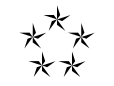
General
Five (5)-Star GeneralOne (1)
One (1)
Eliminates any lower ranking officer, the private and the flag.
General
Four (4)-Star GeneralOne (1)
One (1)
Eliminates any lower ranking officer, the private and the flag.
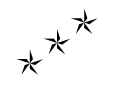
General
Three (3)-Star GeneralOne (1)
One (1)
Eliminates any lower ranking officer, the private and the flag.
General
Two (2)-Star GeneralOne (1)
One (1)
Eliminates any lower ranking officer, the private and the flag.
General
One (1)-Star GeneralOne (1)
One (1)
Eliminates any lower ranking officer, the private and the flag.
Colonel
ColonelOne (1)
One (1)
Eliminates any lower ranking officer, the private and the flag.
Lt. Col.
Lt. ColonelOne (1)
One (1)
Eliminates any lower ranking officer, the private and the flag.
Major
MajorOne (1)
One (1)
Eliminates any lower ranking officer, the private and the flag.
Captain
CaptainOne (1)
One (1)
Eliminates any lower ranking officer, the private and the flag.
1st Lieut.
1st LieutenantOne (1)
One (1)
Eliminates any lower ranking officer, the private and the flag.
2nd Lieut.
2nd LieutenantOne (1)
One (1)
Eliminates any lower ranking officer, the private and the flag.
Sergeant
SergeantOne (1)
One (1)
Eliminates the private and the flag.
Spy
SpyTwo (2)
Two (2)
Eliminates all officers (from the rank of Sergeant up to the five (5)-Star General) and the flag.
Private
PrivateSix (6)
Six (6)
Eliminates the spy and the flag.
Flag
FlagOne (1)
One (1)
The flag can be eliminated by any piece including the opposing flag; a flag eliminates the opposing flag when it takes aggressive action by moving into the same square occupied by the other flag.
04

Battle preparation

Spread out the board as illustrated in Figure A. Arrange your respective sets of pieces on the first three (3) rows on your end of the board with the printed sides facing you. There is no predetermined place for any piece. You are therefore free to arrange the pieces according to your strategy or style of play. Note that as you arrange your pieces on the first three (3) rows, you will find six (6) vacant squares. This is to allow for maneuvering and freedom of movement when play begins.

Private
2nd Lieut.
Major
General
General
General
Captain
1st Lieut.
Private
Spy
Colonel
General
General
Lt. Col.
Spy
Sergeant
Private
Private
Flag
Private
Private
Six vacant squares for maneuvering
Fig A · piece placement
05

Piece movement

1
Any player makes the first move. Players move alternately.
2
A player is allowed to move only one piece at a time.
3
A move consists of pushing a piece to an adjacent square, either forward, backward or sideward. A diagonal move or a move of more than one square is illegal. (See Figure B)
Major
Legal — one square, orthogonal
Illegal — diagonal
Fig B · legal moves
06

Challenging

As the game progresses, challenges are made resulting in the elimination of soldiers. A “challenge” is made when a soldier moves into the same square occupied by an opposing soldier. When a challenge is made the following rules of elimination apply:

a
A higher ranked soldier eliminates from the board a lower ranked soldier.
b
If both soldiers are of equal rank, both are eliminated.
c
A spy eliminates any officer starting with the rank of 5-star General down to the Sergeant.
d
The Flag can be eliminated or captured by any piece including the opponent’s Flag.
e
Only a Private can eliminate the Spy.
f
The Flag that moves into the same square occupied by the other Flag wins the game.
The arbiter

For maximum interest and suspense, a neutral party (arbiter) is present to preside over a challenge for both players. As arbiter, he is not allowed to reveal to either player the ranks of any piece whether engaged in challenges or not. In case of a challenge, the arbiter quietly removes the outranked piece and gives it back to the player who has lost it. Care must be made that the eliminated piece is not shown to the opponent. Official tournament games are conducted with an arbiter.

Without an arbiter

When playing without an arbiter, every time there is a challenge both players must declare the ranks of the two opposing pieces concerned, after which the outranked player removes his piece from the board.

07

End game

The game ends:

a
When the Flag is eliminated or captured.
b
When a Flag reaches the opposite end of the board.
c
When a player resigns.
d
When both players agree on a drawn position.

A Flag reaching the opposite end of the board may still be eliminated by an opposing piece occupying a square adjacent to the one reached by the Flag. In order to win, the Flag should at least be two squares or more ahead of any opposing piece.

?
?
?
Flag
An enemy sits directly beside the square the Flag advances to — it can be captured.
Fig C · wrong move
Opponent can still capture the Flag
?
?
?
Flag
The nearest enemy is two squares away — the Flag is safe and the game is won.
Fig D · right move
Opponent cannot capture the Flag